
One Domain Website Consolidation
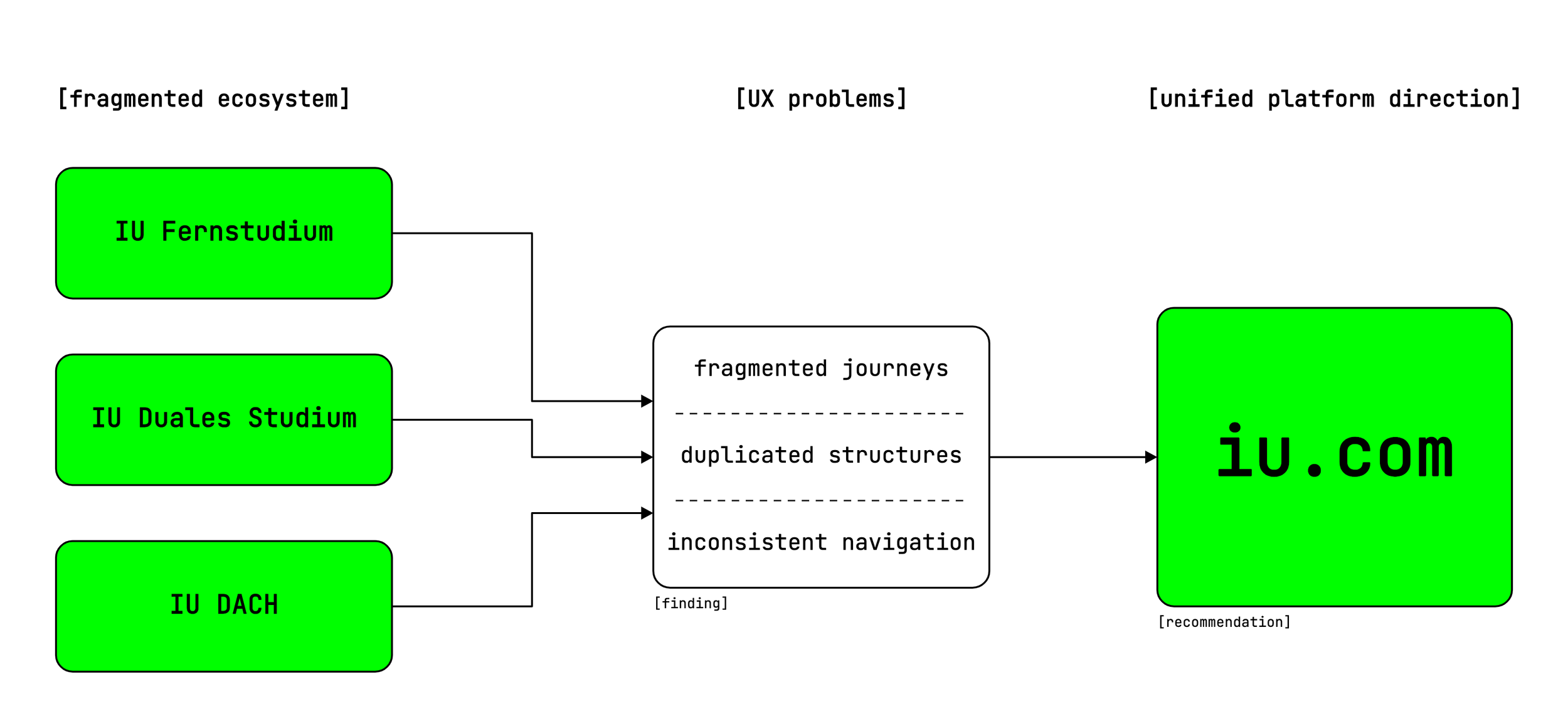
The One Domain project explored how multiple IU website experiences could be brought into a clearer and more consistent platform direction.
I contributed UX research, journey mapping, workshop-based problem framing, usability research synthesis and information architecture recommendations.
Although the full migration was not implemented, the work created reusable UX insights, prioritized opportunity areas and a stronger shared understanding across product, marketing, content, CRM, customer experience and development.
[confidentiality note] Some visuals have been simplified, reconstructed or anonymized to protect confidential information while preserving the project’s UX process, key findings and design rationale.
Research · Journey mapping · Workshop facilitation · Information architecture · Website consolidation
[00]
OVERVIEW
The One Domain project explored how multiple IU website experiences could be brought into a more unified platform structure.
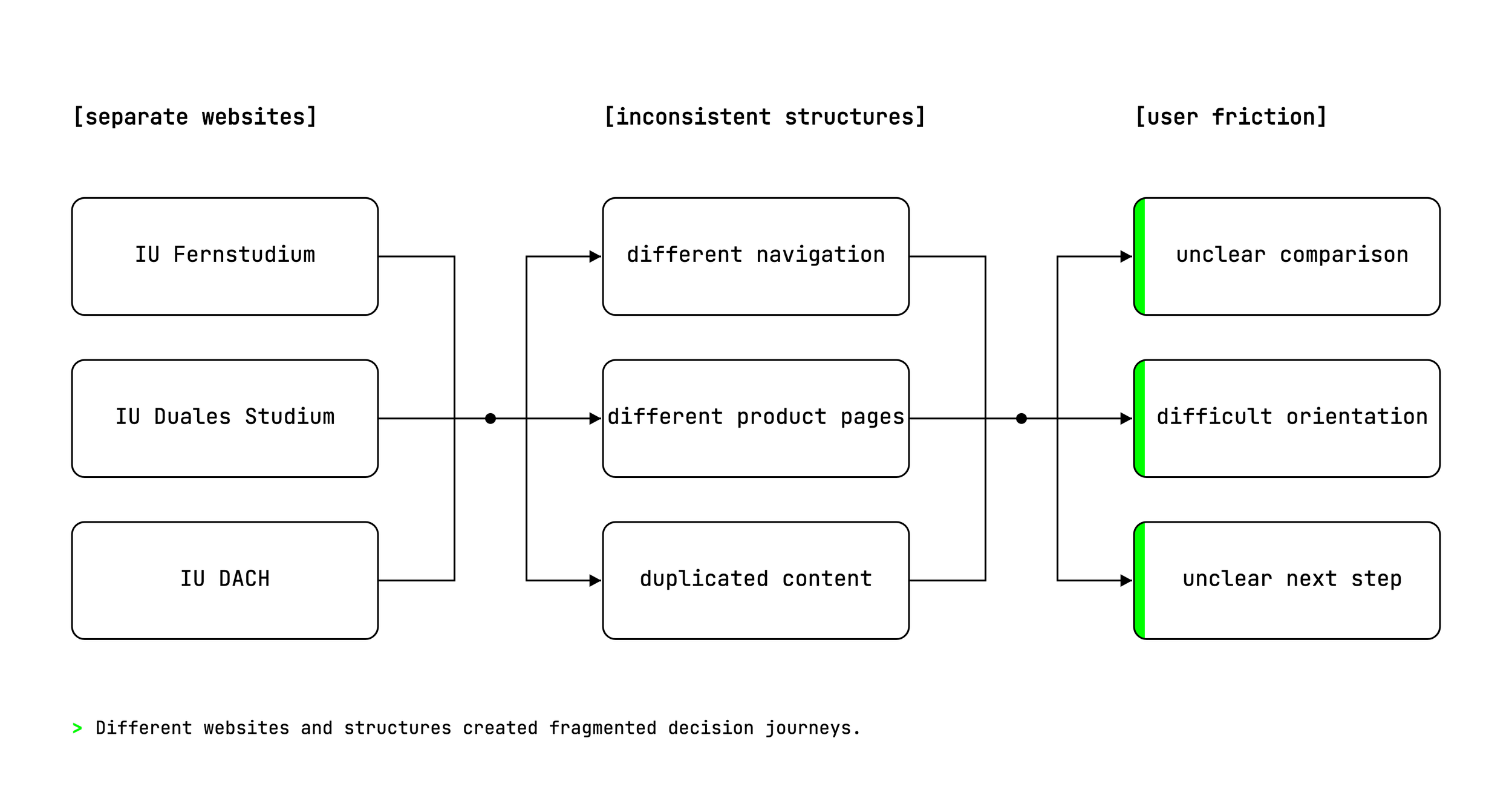
At the time, different study formats and business areas were represented across separate website experiences. This created fragmented journeys, duplicated content structures and inconsistencies in how users discovered, compared and understood study options.
My work focused on the research and problem-framing phase: understanding existing journeys, mapping user needs, supporting workshops, synthesizing pain points and translating findings into information architecture and UX recommendations.
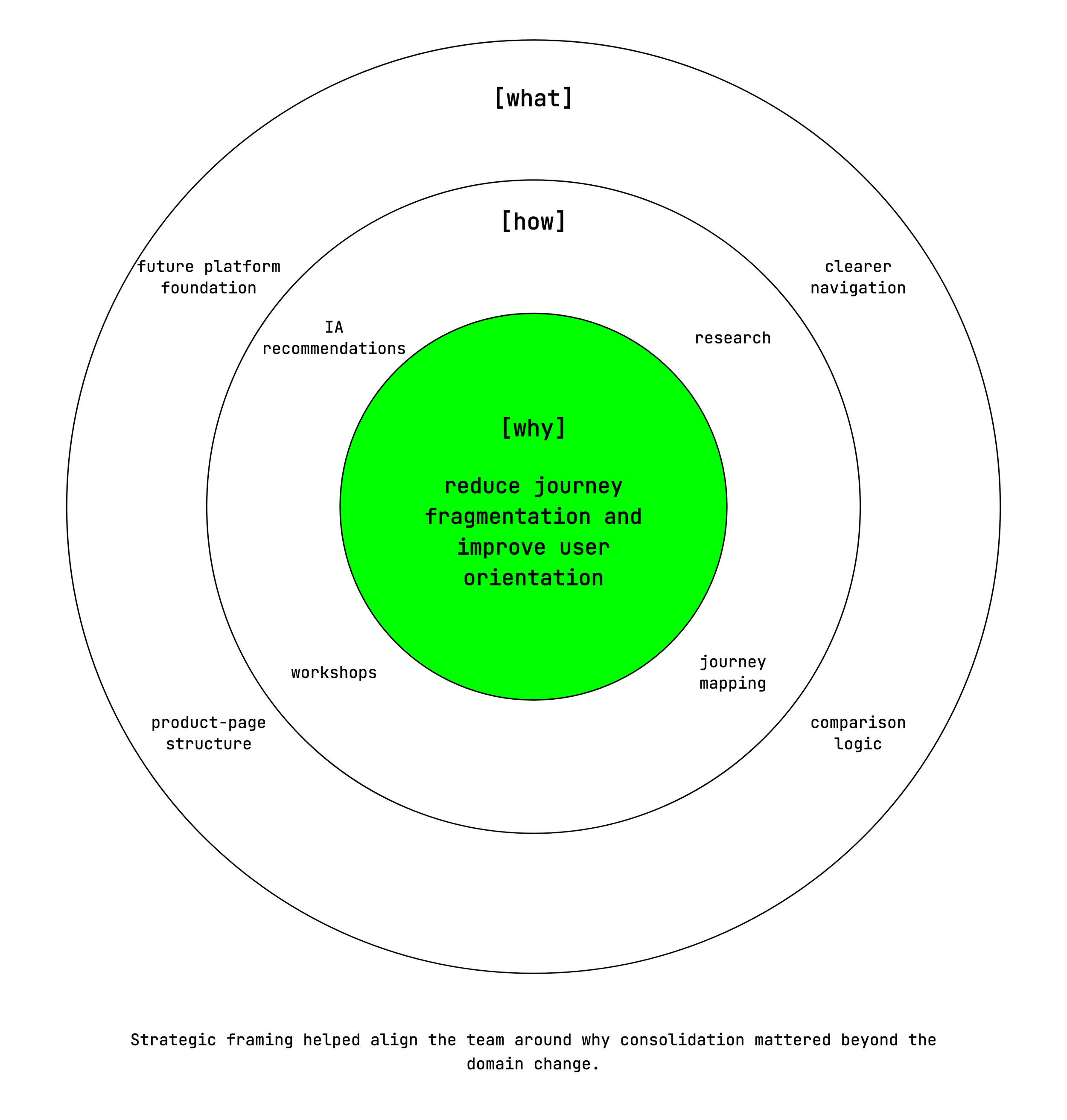
The goal was to create a clearer foundation for future website work, not only by proposing screens, but by helping the team understand where the current ecosystem created friction and which areas should be prioritized.
Project details:
Role: UX Designer / Product Designer
Company: IU Internationale Hochschule
Product area: IU website ecosystem
Focus: UX research, journey mapping, workshop facilitation, information architecture, usability testing, website consolidation
Collaborators: product owners, developers, marketing, CRM, content managers, customer experience and business stakeholders
[01]
CHALLENGE
The challenge was not only to combine several websites into one domain. The deeper UX challenge was to understand how different user needs, study formats, business requirements and content structures could be represented in one clearer platform experience.
Users needed to answer questions such as: What can I study? Which study format fits me? How do the options differ? What are the requirements? What should I do next?
Across the existing ecosystem, these answers were distributed across different pages, navigation structures and product areas. This made orientation harder and increased the risk that users would rely on search, jump between pages or leave without a clear next step.
Key challenges included fragmented journeys across multiple websites, inconsistent navigation patterns, unclear differences between study formats, duplicated content areas, complex product-page hierarchies and the need to align many internal stakeholders around one future direction.
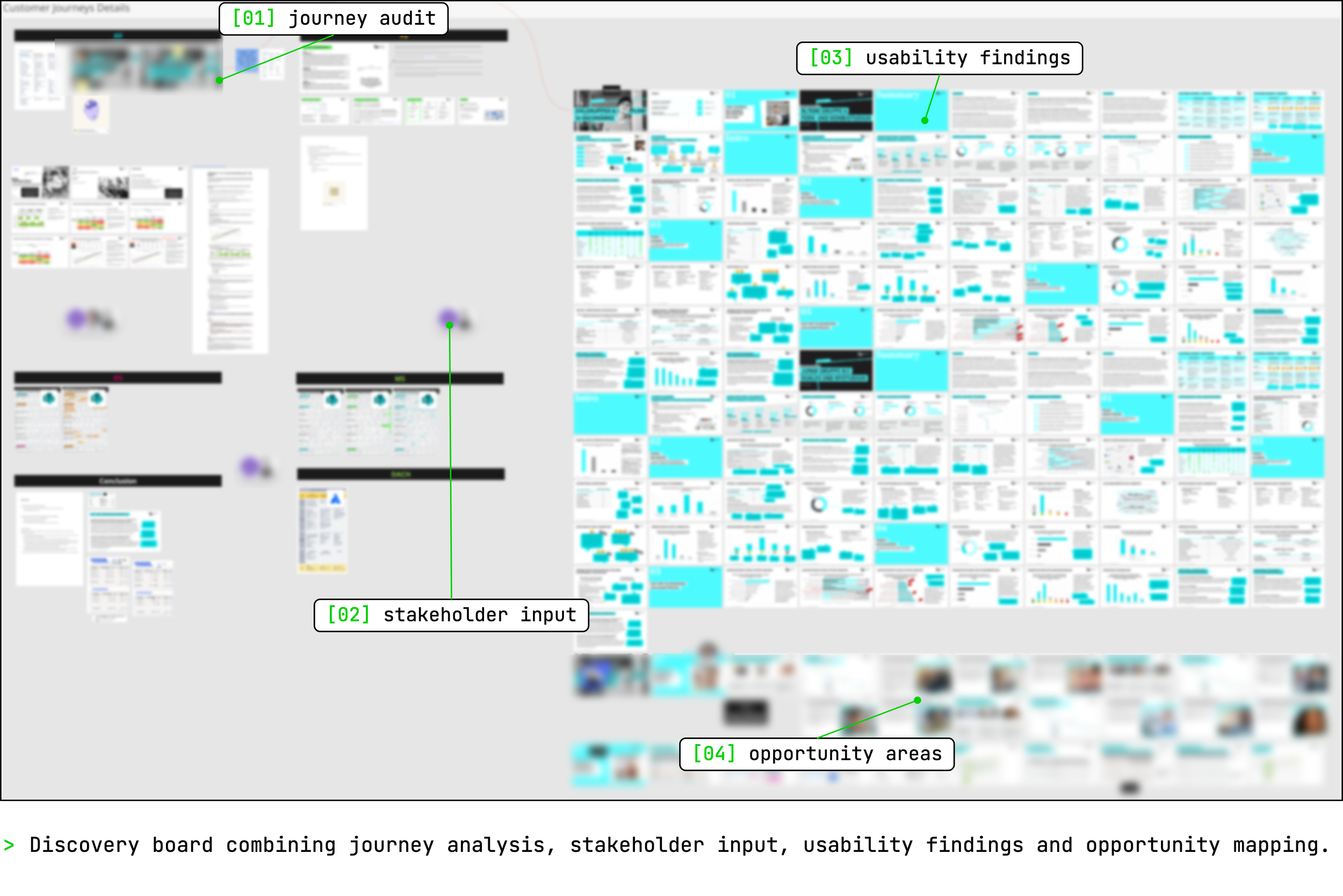
We started with a discovery phase to understand the current website ecosystem before proposing solutions.
The research included reviewing existing website journeys, analyzing navigation structures, collecting stakeholder input, reviewing previous UX audit findings and usability insights, and mapping where users experienced friction across the decision journey.
A central part of the work was turning scattered input into a shared working structure. I helped prepare and structure workshop materials in FigJam/Figma, mapped findings visually and supported discussions with product, marketing, CRM, content, customer experience and development stakeholders.
The workshops helped the team align around three questions:
What do users need to understand before they can choose a study path?
Where does the current website ecosystem create confusion or unnecessary effort?
Which areas should be prioritized for a future unified experience?
This helped the team move from a broad platform idea to concrete UX problem areas.
RESEARCH & WORKSHOP SETUP
[02]
[03]
USER GROUPS & JOURNEY MAPPING
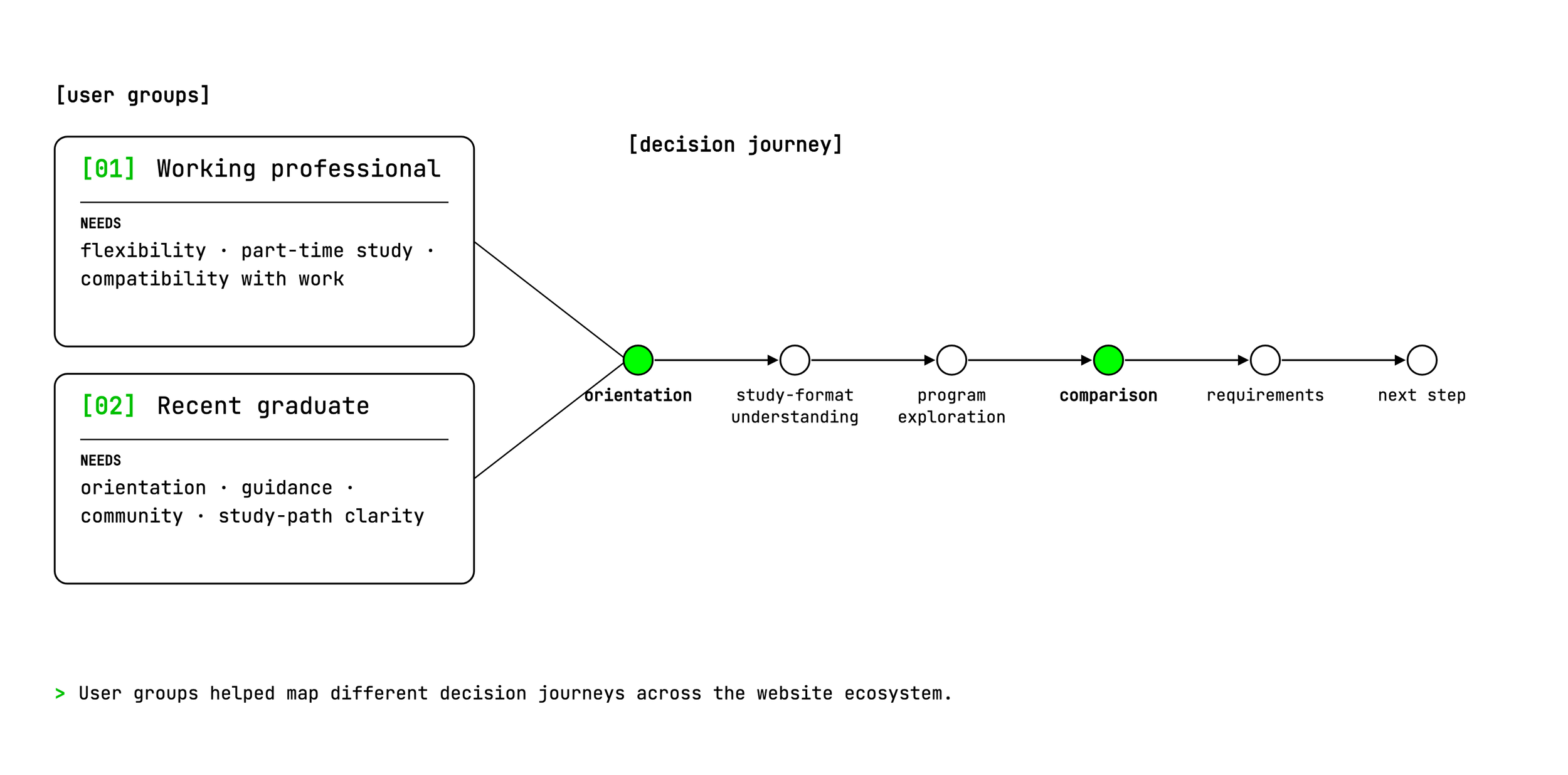
The existing websites served different audiences with different levels of intent.
Some users were working professionals looking for flexibility, part-time study options and compatibility with work or family life. Others were recent graduates looking for orientation, guidance, community and support in choosing the right study path.
Instead of treating these as static personas, we used them as a way to understand different decision journeys. We mapped the questions, actions, emotions and potential barriers users experienced when moving from initial interest to comparing options and taking a next step.
The journey maps helped the team see where users needed orientation, where they needed comparison, where they needed reassurance and where the website needed to provide a clearer call to action.
This created a shared view of the user journey across teams and helped connect content, navigation and product-page decisions to actual user needs.
[04]
JOURNEY MAPPING
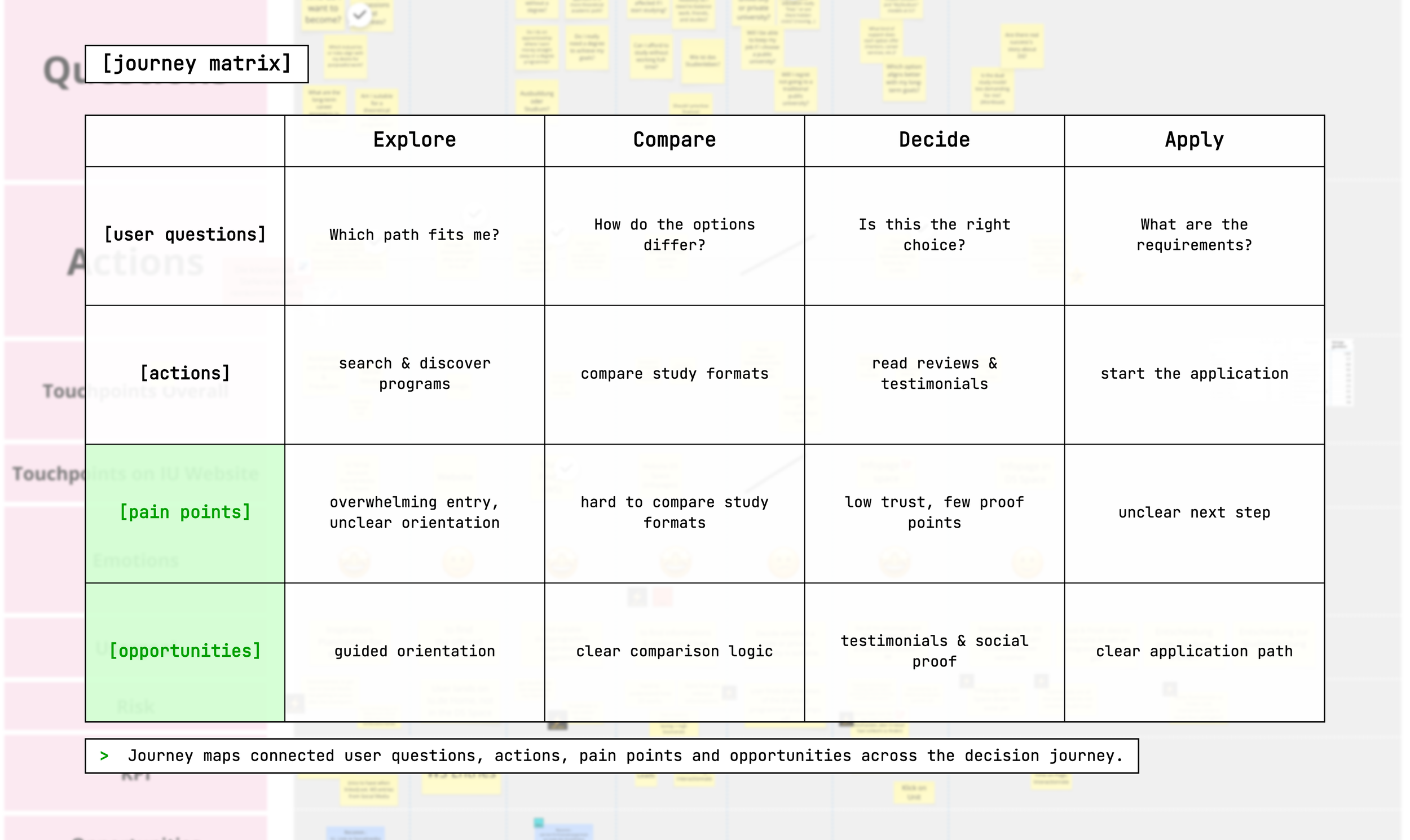
After defining the key user groups, we mapped their journeys across the existing website ecosystem.
The mapping focused on what users were trying to understand at each stage, which actions they needed to take, what emotions or uncertainties appeared and where the website experience created friction.
This helped us move from individual page-level observations to a broader view of the end-to-end decision journey.
The journey maps also created a practical workshop artifact. They helped stakeholders discuss user problems in context instead of focusing only on isolated pages or internal content structures.
[05]
PAIN POINTS & OPPORTUNITY MAPPING
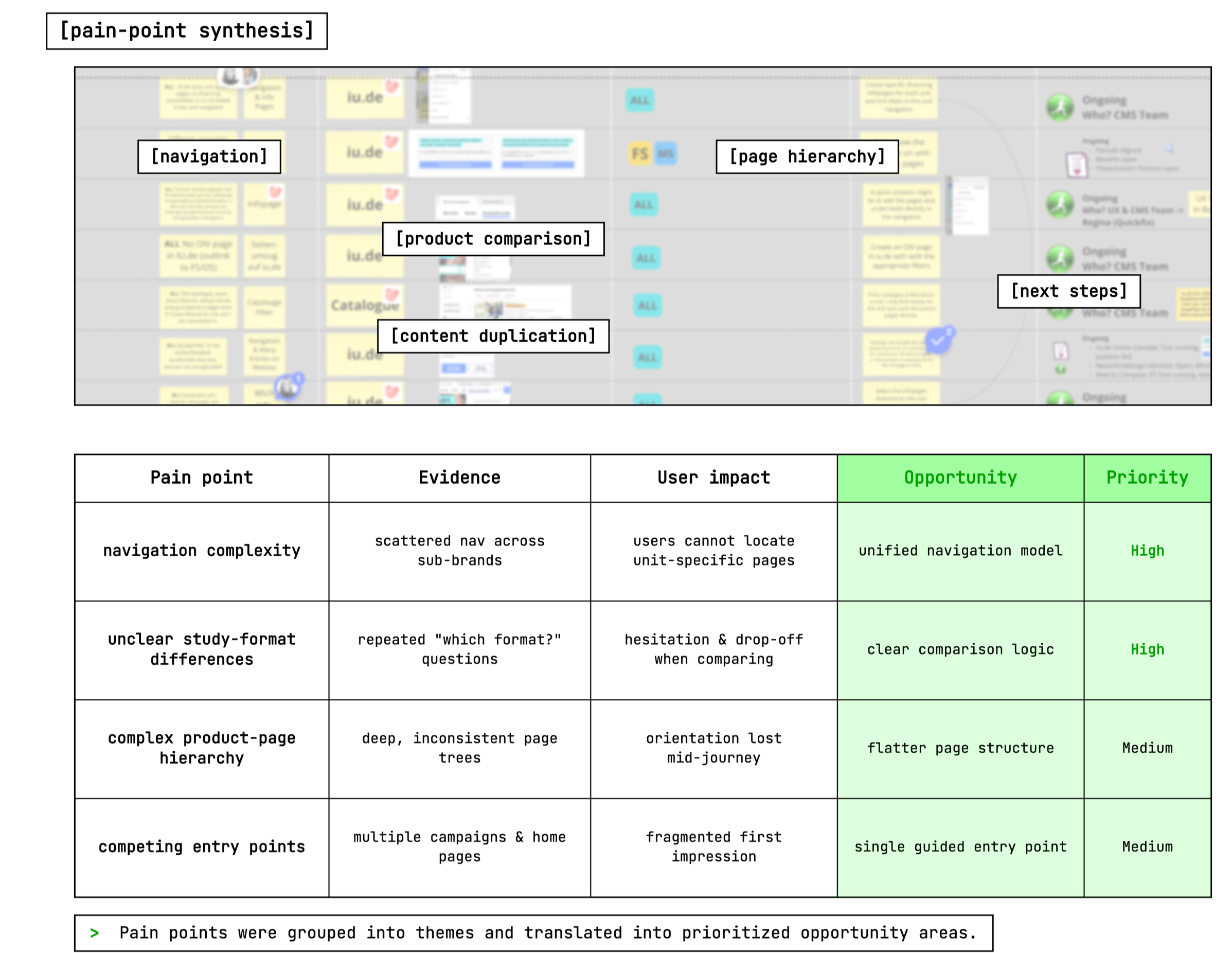
Once the journeys were mapped, we translated research findings into pain points and opportunity areas.
The strongest themes were navigation complexity, unclear differences between study formats, inconsistent product-page structures and too many competing entry points. Users needed clearer orientation before they could confidently move toward a decision.
Together with the team, we grouped pain points by theme and mapped them against the parts of the journey where they appeared. This made it easier to prioritize which areas needed attention and which areas could become part of a longer-term platform direction.
The main opportunity areas were simplifying navigation, improving findability, making study formats easier to compare, restructuring product-page information and creating clearer next steps based on user intent.
This part of the work was important because it turned research into product direction.
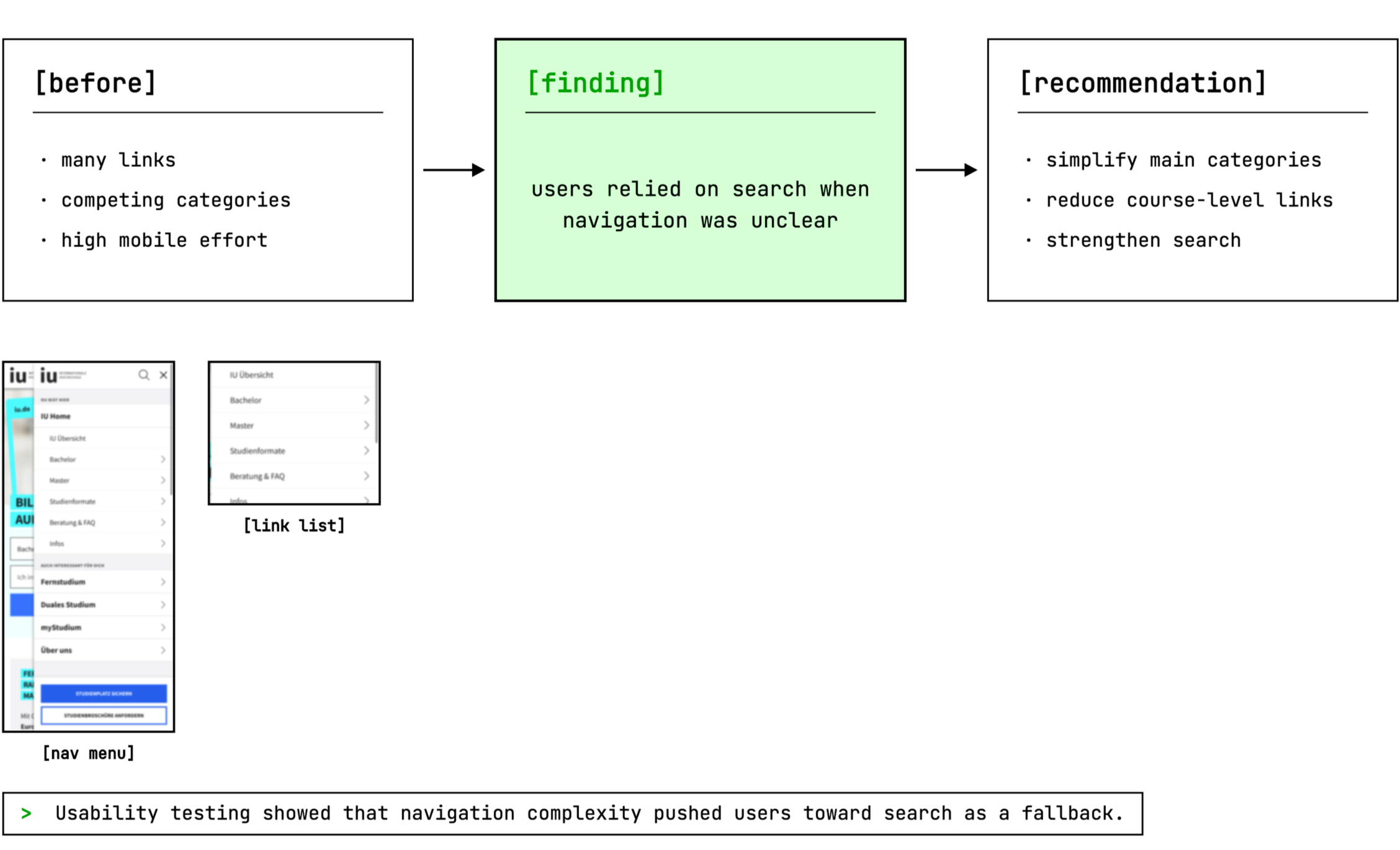
Navigation became one of the most important focus areas.
Usability testing showed that users often relied on search when they could not find the right entry point through the navigation. The existing navigation contained many links and competing categories, which made orientation harder, especially on mobile.
Based on the findings, I recommended simplifying the navigation structure, reducing unnecessary course-level links and making the main categories easier to understand. I also suggested strengthening the on-page search experience for users who already knew what they were looking for.
The goal was to reduce cognitive effort and help users reach the right area faster without exposing every possible option at once.
NAVIGATION & FINDABILITY
[06]
[07]
PRODUCT COMPARISON
Another recurring pain point was product comparison.
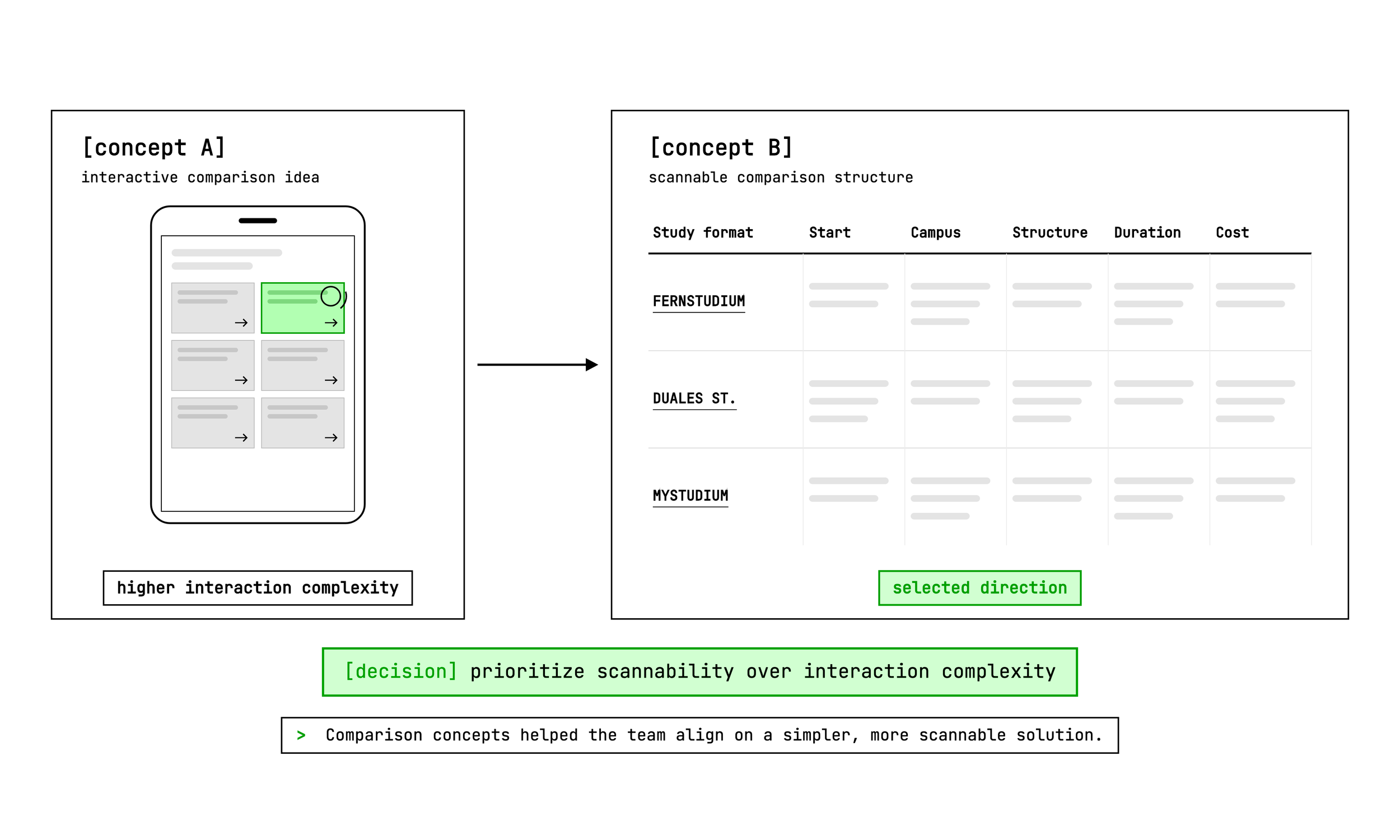
Users often struggled to understand the differences between study formats such as Fernstudium, Duales Studium and myStudium. This made it harder to decide which option matched their needs.
I explored different ways to support comparison, including a more interactive concept and a simpler comparison structure. After reviewing the options with stakeholders, we aligned on a clearer and more scannable comparison approach.
The final recommendation prioritized clarity over interaction complexity. Instead of adding a complex tool too early, the comparison structure focused on helping users quickly understand the main differences between study formats and continue with more confidence.
ENTRY-POINT EXPLORATION
[08]
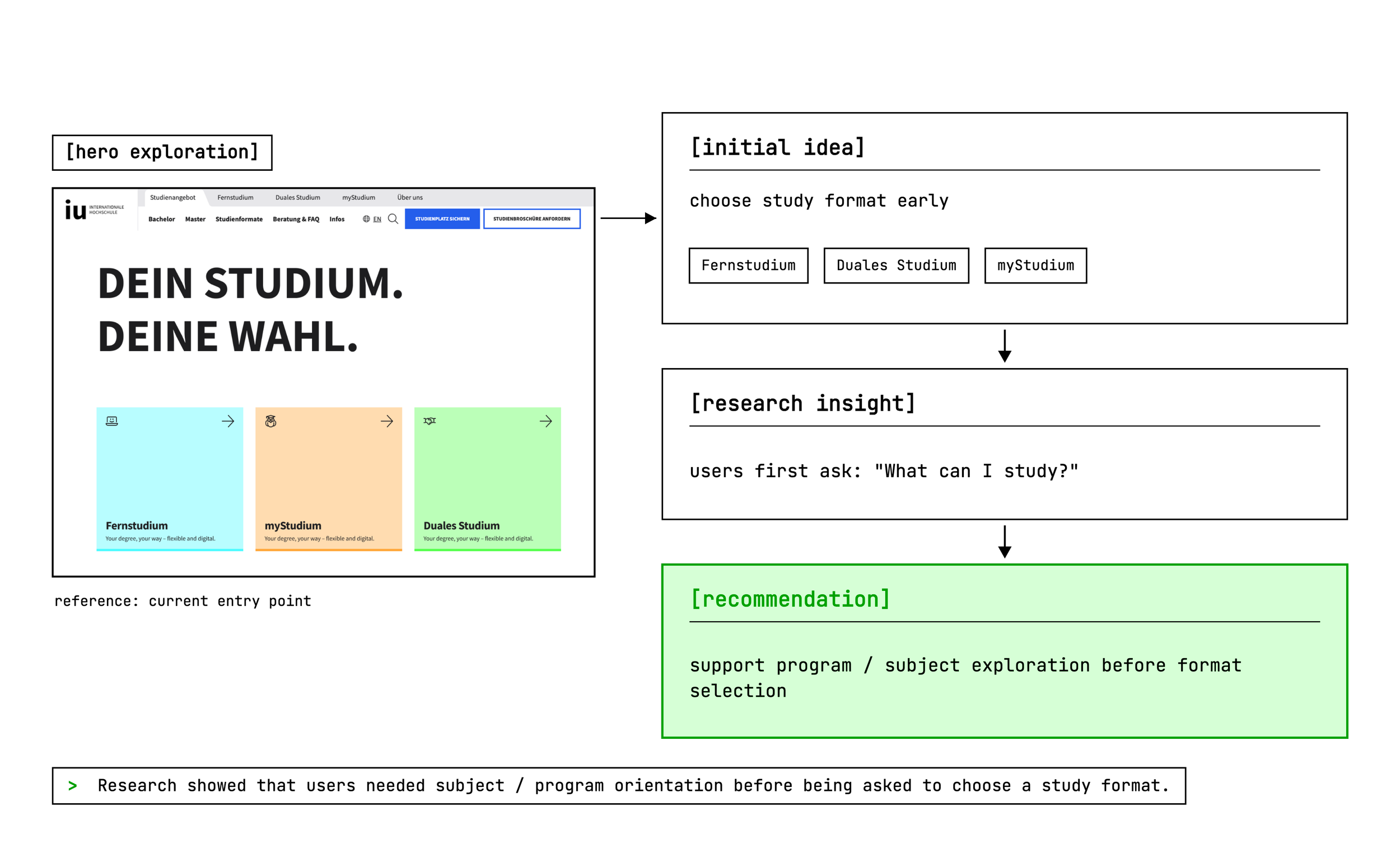
We also explored whether the homepage hero could help users choose the right study format earlier in the journey.
The initial idea was to use the hero area as a direct entry point into different study formats. However, research showed that many users first wanted to understand what they could study before deciding how they wanted to study.
This changed the direction. Instead of pushing users too early into a study-format choice, the recommendation was to support exploration first and guide users toward the relevant format once they had more context.
This was an important insight: internal business categories do not always match the user’s mental model.
[09]
PRODUCT PAGE HIERARCHY
The product pages were another important area of complexity.
The existing structure contained many layers of information, which made it difficult for users to scan relevant details and understand what mattered most at each decision stage.
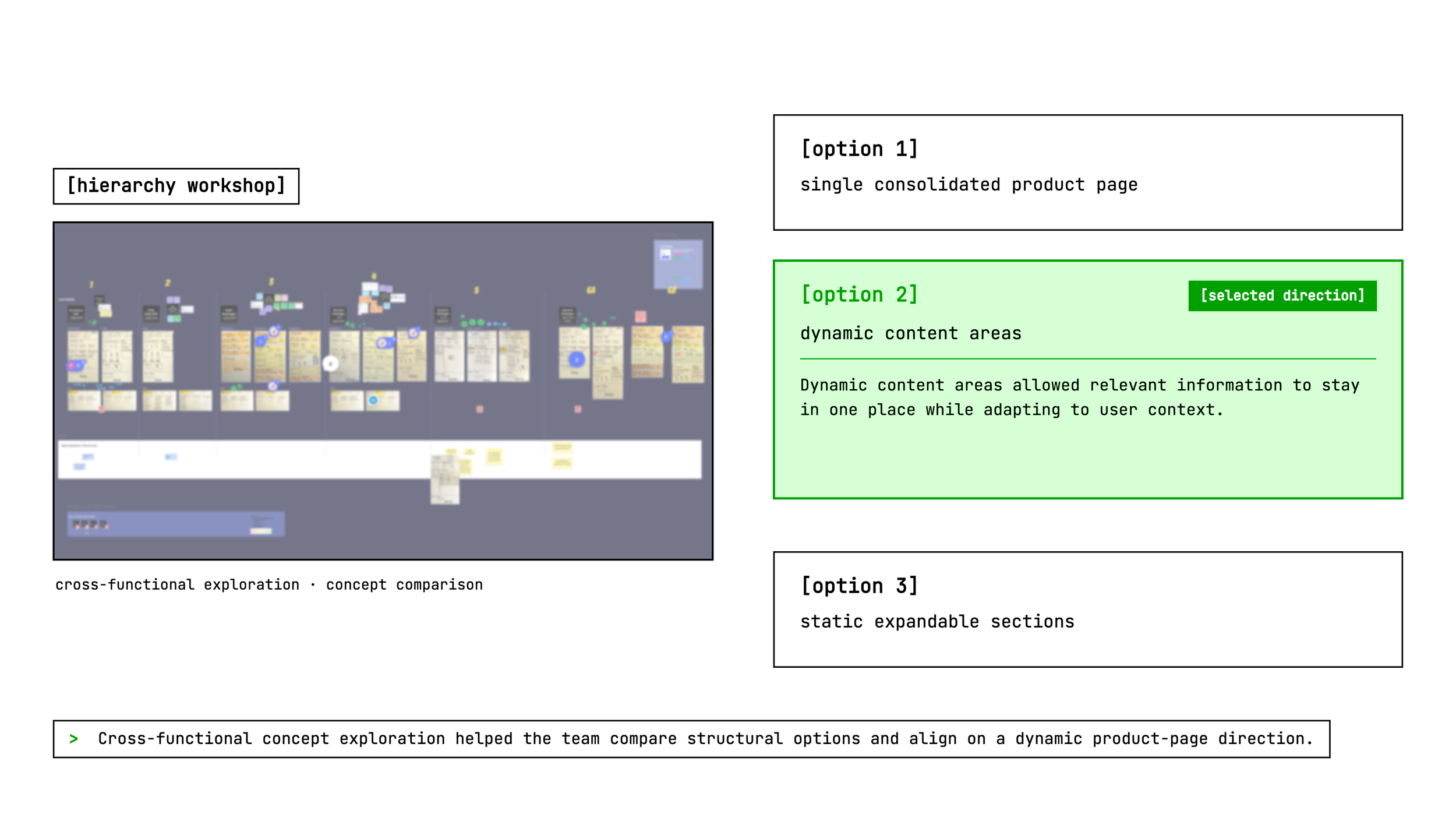
In a cross-functional taskforce, we explored different ways to simplify the product-page hierarchy. I prepared and presented structural options, including a single consolidated product page, a page with dynamic content areas and a page with static expandable sections.
Together with the team, we selected the dynamic-elements approach as the strongest direction. This allowed users to access relevant information in one place without navigating through multiple pages, while still giving the team flexibility to adapt content based on context.
The work moved from low-fidelity exploration to a clearer product-page concept and created a foundation for future improvements.
[10]
OUTCOME
The project concluded at the research and direction-setting stage rather than progressing to a full migration. It created a reusable UX foundation for future website and platform work.
Key outputs included:
a shared view of fragmented user journeys across the website ecosystem
prioritized navigation and information architecture pain points
reusable journey maps connecting user questions, actions and barriers
clearer comparison principles for different study formats
recommendations for entry points and product-page hierarchy
stronger alignment across product, marketing, content, CRM, customer experience and development
The main value was not a final launch, but a shared evidence base that translated broad platform discussions into concrete UX opportunity areas and recommendations.
[11]
LEARNINGS
[01] Consolidation is not only a technical migration. Bringing websites together requires a shared understanding of user journeys, content structures, business goals and technical constraints.
[02] Workshops help make complexity visible. Visual mapping and structured workshop formats helped stakeholders discuss abstract platform problems through concrete user journeys and pain points.
[03] Navigation needs to reflect user mental models. Internal structures are not always how users think. Navigation should help users understand where to go next without needing to understand the organization behind the website.
[04] Simpler solutions can be stronger. For product comparison, the strongest direction was not the most interactive concept, but the one that helped users understand differences quickly.
[05] Strategic UX work can create value without a full launch. Even though the full migration was not implemented, the project produced reusable insights, prioritized opportunities and recommendations that supported future platform decisions.